The one tool you cannot skip
A thermometer. Jerky safety comes down to two temperature questions: what is your dehydrator or oven really doing, and did the meat reach 160°F (165°F for poultry)? Dials do not answer either. The Pacific Northwest extension bulletin says home dehydrators can read as much as 40°F away from the dial setting, and Ohio State says even units with temperature controls may be inaccurate, so test the empty unit with a thermometer.
You need two kinds of thermometer, and they are not interchangeable:
- An air thermometer for the dehydrator or oven. A dial or digital instant-read works. Ohio State describes using a bi-metallic stemmed thermometer for this, and the Pacific Northwest bulletin says either dial or digital instant-read will measure air temperature.
- A thin-tipped digital probe for the meat. The bulletin says a dial thermometer reads the bottom 2 inches of its stem, which is too much for a thin strip, while a thin-tipped thermometer senses temperature in thin meat. This is what verifies the heat step.
The dehydrator, if you buy one
The Pacific Northwest bulletin lists features to look for:
- An instruction manual.
- A thermostatically controlled dial that can maintain 145 to 155°F. Avoid units with a fixed preset temperature you cannot change.
- A fan that distributes warm air evenly across all trays.
- Shelves of stainless steel or food-grade plastic.
- Easy loading and unloading.
- An enclosed heating element and a hard plastic, aluminum, or steel exterior, ideally double-walled.
- A suitable number of trays for the batches you make.
- A parts list for replacements.
Horizontal airflow, with the fan at the back, means you need not rotate trays. Vertical airflow units need rotation every couple of hours per Ohio State. We do not recommend a specific brand here. The method comparison covers oven and smoker options if you are deciding whether to buy.
Oven drying kit
If you dry in the oven, you need wire cooling racks that fit rimmed baking sheets, a wooden spoon or similar prop for the door, and a thermometer that hangs or stands in the oven. Kansas State and the National Center for Home Food Preservation describe cake racks on baking sheets for oven drying. A small fan near the open door helps move moisture, per Ohio State.
Cutting and prep
- A long, sharp slicing knife. Sharp knives glide through firm meat and give even strips.
- A cutting board you can sanitize, kept for raw meat. The Pacific Northwest bulletin says to sanitize washed boards and tools in 1 tablespoon of chlorine bleach per gallon of room temperature water, then air dry.
- A rolling pin for flattening strips to uniform thickness, as the bulletin suggests.
- A ruler to check a quarter inch. It sounds silly until you measure.
- A kitchen scale. It is not an extension requirement, but weighing meat and seasoning makes batches repeatable, and weighing a finished batch gives a rough yield check against the 4 ounce per pound figure from the sources.
- Tongs and clean plastic gloves. The Alaska extension publication recommends gloves, forks, or tongs for handling meat.
For marinating
Shallow glass or food-grade plastic containers, or one gallon resealable food-grade bags, which the Pacific Northwest bulletin uses for marinating. Plan fridge space.
For ground jerky
A jerky gun with strip and round nozzles, for ground meat. See ground meat jerky with a jerky gun. A baking sheet is needed for the heat step. A mixing bowl large enough to knead the meat.
Packaging and storage
- Glass jars with tight lids, heavy food-storage bags, or vacuum-sealer bags, all mentioned in the extension publications.
- A vacuum sealer is optional. The Pacific Northwest bulletin says vacuum packaging reduces oxidation and eliminates the possibility of mold growth in the package.
- Paper towels for blotting oil.
- Labels and a marker. The bulletin says to label by meat type, treatment, and date.
- Freezer space, which does more for jerky longevity than any gadget. See how to store jerky.
What you can skip
- Gadgets that promise to season jerky faster. Marinate in the refrigerator and use time instead.
- A water activity meter. The Pacific Northwest bulletin notes that measuring water activity needs equipment not available to consumers, and it substitutes the bend test and conditioning. A professional or serious hobbyist may want one, and we do not say the sources require it.
- Fancy slicers, unless you make jerky every week. A sharp knife and a freezer do the job.
- Cure and specialty additives for your first batch. See do you need curing salt.
- Microwave cookware. Alaska says microwaves cannot be relied on to make safe jerky.
A sensible starter list
If you are starting from nothing: a thin-tipped digital thermometer, an air thermometer, a sharp knife, wire racks and baking sheets or a dehydrator with an adjustable dial, paper towels, airtight containers, and labels. That covers the safety steps and is enough to run the dehydrator method or the oven method. Everything else is convenience.
Product links, where we have them, appear on the equipment page. We name product types here and do not claim to have tested specific models.
Sources
Gear for this
As an Amazon Associate we earn from qualifying purchases. These are listings we verified, not products we tested. How our links work.

Dehydrators, The upgrade pick
Cosori 6-tray stainless steel dehydrator
Six stainless trays give a full 3-4 lb batch of strips room to breathe, and adjustable temperature lets you dry at the temperature your tested recipe calls for.
View on Amazon (opens Amazon in a new tab)
Dehydrators, First dehydrator on a budget
Cosori 5-tray dehydrator (165F max)
A compact, low-cost starter with adjustable temperature that tops out at 165F, check that your recipe's drying and pre-heat temperatures fit under that ceiling.
View on Amazon (opens Amazon in a new tab)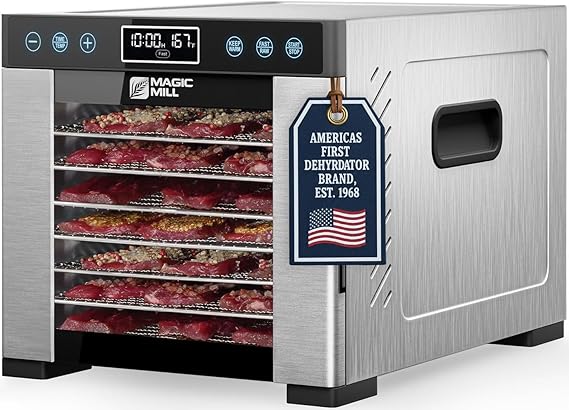
Dehydrators, Bigger batches, even airflow
Magic Mill Pro rear-fan dehydrator
A rear-mounted fan pushes air across every tray, which cuts the tray-rotating chore on big batches.
View on Amazon (opens Amazon in a new tab)