What every method has to do
Any jerky tool has the same three jobs: hold a low steady temperature, move air across the meat so moisture leaves, and let you verify the heat step. The Pacific Northwest extension bulletin calls an electric dehydrator the way to the best-quality jerky and an oven with the door propped open an acceptable alternative. It does not recommend solar drying, and Ohio State agrees, citing an unsteady heat source and contamination risk.
Dehydrator
A dehydrator has a heater, a fan, and trays, which is exactly what drying needs. The Pacific Northwest bulletin says a good one has a thermostatic dial that can hold 145 to 155°F and a fan that distributes air evenly. It also warns that home units vary: some take 30 minutes to 4 hours to reach temperature when loaded, some swing 30 to 40°F, and the air temperature can differ from the dial by as much as 40°F. Buy one with an adjustable dial, test it empty with a thermometer, and you have the most consistent tool. See how to make jerky in a dehydrator.
Oven
An oven works, with limits. The Pacific Northwest bulletin says oven drying generally takes two to three times as long as a dehydrator because there is no fan, and that you should test the oven with a thermometer for about an hour with the door propped open; if it cannot hold 145 to 155°F, do not dry meat in it. Too hot and the surface crusts and traps moisture. Too cool and the meat may spoil before it dries. Ohio State gives a wider range of 145 to 170°F and suggests a fan by the open door. Many home ovens will not go that low, which is the main obstacle. The oven also does the 275°F finishing step well. See how to make jerky in the oven.
Smoker
A smoker adds flavor, and NDSU gives rules for it: dry at 140 to 150°F, make sure the product reaches at least 160°F, apply smoke as the meat comes up to a fully cooked temperature, and do not smoke low and finish hot. Many smokers hold temperature well but vary by model, and you still need a thermometer in the strips. Details are in smoking jerky: wood and temperature.
Air fryer
We could not find an extension or USDA publication on making jerky in an air fryer, so there is no sourced temperature or time to give you. An air fryer is a small, strong-fan convection oven, and many models do not set as low as drying temperatures. If yours does, treat it like a small oven: verify the real temperature with a thermometer, do the heat step to 160°F or 165°F, and use the bend test for doneness. That advice is our reasoning from how the other methods work, not a tested procedure.
Microwave
Skip it. The Alaska extension publication says microwaves cannot be relied on to make a safe jerky because the heat is rapid and uneven, so it is hard to know whether strips reached a safe temperature.
What none of them change
Every tool leaves the same rules in place. Strips stay at a quarter inch or less. Meat stays cold until it goes in. The heat step brings red meat, pork, and game to 160°F and poultry to 165°F, either by precooking or by 10 minutes in a 275°F oven after drying. Doneness is the bend test. Packaging waits until the jerky is cool, and conditioning happens before storage. A better tool makes the drying easier and more even. It does not remove a single safety step.
Cost and time at a glance
A dehydrator takes the least attention and the shortest time, since the Pacific Northwest bulletin puts oven drying at two to three times longer. An oven costs nothing extra but ties up the kitchen. A smoker costs fuel and attention, and gives flavor nothing else matches. We have no sourced air fryer figures. If you cook jerky weekly, a dehydrator is the tool that pays for itself. If you cook it twice a year, use the oven.
Quick pick
- Want consistency: dehydrator with a real dial.
- Have nothing but an oven: use the oven, but verify it holds the low temperature.
- Want smoke: smoker, with the thermometer in the strips.
- Own only an air fryer: proceed carefully and with a thermometer.
Whichever tool you pick, the heat step does not change. And the gear guide explains why a thermometer beats every other accessory.
Sources
Gear for this
As an Amazon Associate we earn from qualifying purchases. These are listings we verified, not products we tested. How our links work.

Dehydrators, The upgrade pick
Cosori 6-tray stainless steel dehydrator
Six stainless trays give a full 3-4 lb batch of strips room to breathe, and adjustable temperature lets you dry at the temperature your tested recipe calls for.
View on Amazon (opens Amazon in a new tab)
Dehydrators, First dehydrator on a budget
Cosori 5-tray dehydrator (165F max)
A compact, low-cost starter with adjustable temperature that tops out at 165F, check that your recipe's drying and pre-heat temperatures fit under that ceiling.
View on Amazon (opens Amazon in a new tab)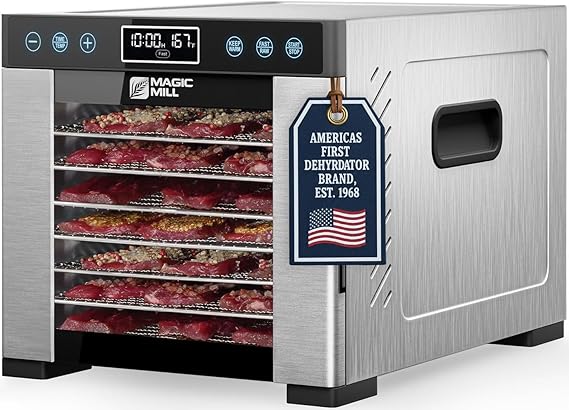
Dehydrators, Bigger batches, even airflow
Magic Mill Pro rear-fan dehydrator
A rear-mounted fan pushes air across every tray, which cuts the tray-rotating chore on big batches.
View on Amazon (opens Amazon in a new tab)