Ingredients
- 1 lb (450 g) lean beef, such as eye of round or top round, trimmed
- 3 tablespoons soy sauce
- 1 tablespoon Worcestershire sauce
- 1 tablespoon brown sugar, packed
- 1 tablespoon rice vinegar
- 1 teaspoon fresh ginger, finely grated
- 1 garlic clove, crushed
- 1/4 teaspoon black pepper
- Vegetable oil or nonstick spray for the trays
Method
- Trim every visible bit of fat, silver skin, and gristle from the meat. Wrap it and freeze it until firm but not solid, about 1 to 2 hours depending on the size of the piece.
- Slice the firm meat into strips 1/8 to 1/4 inch thick (never thicker than 1/4 inch), about 1 to 1.5 inches wide. Cut with the grain for a chewy jerky or across the grain for a tender, snappier one.
- Stir the soy sauce, Worcestershire sauce, brown sugar, rice vinegar, ginger, garlic, and pepper in a bowl until the sugar dissolves. Add the strips and turn to coat, or seal everything in a 1 gallon food-grade bag and massage gently.
- Refrigerate 4 to 8 hours, turning once or twice. Soy is salty and drying concentrates salt, so do not go much beyond overnight.
- Drain the strips on clean paper towels and pat the surface dry. Discard the used marinade.
- Test your dehydrator empty with a thermometer and set it to 145°F, preheating for 15 to 30 minutes. Lay the drained strips on the trays close together without touching or overlapping, with some open space for air. Rotate trays every 2 hours if your unit has vertical airflow.
- Dry until a cooled test piece cracks but does not break when bent, with no damp spots. Start checking after 3 hours; cool each test piece before bending it, because hot jerky feels softer than it is.
- Heat step: lay the dried strips in a single layer on a baking sheet, close together but not touching, and place them in an oven preheated to 275°F for 10 minutes (strips 1/4 inch thick or thinner). Thicker strips need longer. Check a few of the thickest strips with a thin-tipped thermometer: they must read at least 160°F. Do this right after drying, while the strips are still warm.
- Blot beads of oil with paper towels and cool the jerky completely to room temperature. Never pack it warm.
- Condition it: loosely pack cooled jerky in a container about two-thirds full, seal, and shake daily for 2 to 4 days. If moisture shows on the lid, return the jerky to the dehydrator or oven. Then pack airtight, label with the date, and refrigerate or freeze.
Why this one first
Teriyaki is forgiving. The sugar softens the soy's edge, the ginger and garlic cover small slicing mistakes, and the flavor reads as jerky even if your texture lands a bit off on the first try. If you have never made jerky, make this one and write down the real time your dehydrator needed.
Notes on the method
The meat does the work, so choose a very lean cut and trim it hard. The marinade ratios sit between the National Center for Home Food Preservation marinade (1/4 cup soy for 1.5 to 2 lb) and the Pacific Northwest recipe (2 tablespoons soy for 1 lb), plus sugar and acid for the teriyaki profile. Marinating longer than overnight makes it noticeably saltier, as Kansas State notes.
If you prefer to precook instead of using the oven step, bake the seasoned raw strips at 325°F on a rack over a baking sheet until a thin-tipped thermometer reads 160°F, then go straight to the dehydrator. Precooked strips dry faster and come out with a softer, more cooked texture.
Variations
Swap the rice vinegar for pineapple juice for a sweeter edge, or add 1/4 teaspoon red pepper flakes for gentle heat. Change one variable at a time so you know what did what.
The quantities are scaled from tested extension marinades (the National Center for Home Food Preservation and Pacific Northwest recipes). The flavor variations are this site's own formulation and have not been lab tested.
Sources
Gear for this method
As an Amazon Associate we earn from qualifying purchases. These are listings we verified, not products we tested. How our links work.

Dehydrators, The upgrade pick
Cosori 6-tray stainless steel dehydrator
Six stainless trays give a full 3-4 lb batch of strips room to breathe, and adjustable temperature lets you dry at the temperature your tested recipe calls for.
View on Amazon (opens Amazon in a new tab)
Dehydrators, First dehydrator on a budget
Cosori 5-tray dehydrator (165F max)
A compact, low-cost starter with adjustable temperature that tops out at 165F, check that your recipe's drying and pre-heat temperatures fit under that ceiling.
View on Amazon (opens Amazon in a new tab)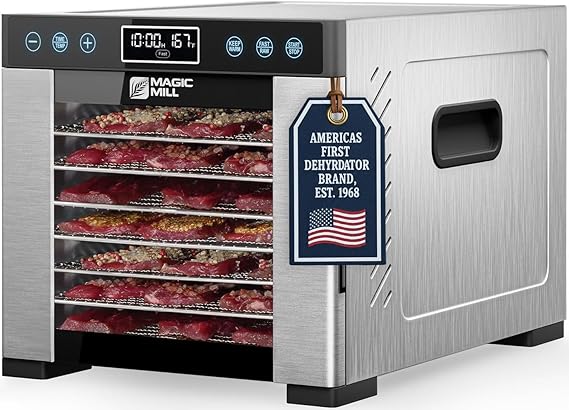
Dehydrators, Bigger batches, even airflow
Magic Mill Pro rear-fan dehydrator
A rear-mounted fan pushes air across every tray, which cuts the tray-rotating chore on big batches.
View on Amazon (opens Amazon in a new tab)