Why a dehydrator is the default
A dehydrator is built for this job: a heater, a fan, and stacked trays that let air sweep across every strip. The Pacific Northwest extension bulletin says an electric dehydrator produces the best-quality jerky. It also says home units vary a lot. Some take anywhere from 30 minutes to 4 hours to come up to temperature when loaded, some swing 30 to 40°F while running, and the air inside can differ from the dial setting by as much as 40°F. So the first step is not the meat. It is finding out what your machine really does.
Step 1: test the dehydrator empty
Ohio State gives a method. For a unit with a fan at the back (horizontal airflow), put a thermometer inside, close the door, and run it. For a unit with a fan on the top or bottom (vertical airflow), put three trays on the base, insert the thermometer stem between the top two trays with the dial outside, and add the cover. Run it at its hottest setting, wait several minutes for the reading to settle, and record it. If it has several settings, test each one.
Then compare against what the sources want. Ohio State says a dehydrator must reach at least 145°F to be used for jerky, and the Pacific Northwest bulletin recommends a dial that holds 145 to 155°F. Other sources are lower: Kansas State, citing USDA, says to maintain 130 to 140°F, and the National Center for Home Food Preservation says 140°F. Our recipes use 145°F because it sits at or above the low end of every source, and because the heat step is what guarantees safety. If your unit has a fixed preset that cannot be adjusted, the Pacific Northwest bulletin says not to use it for jerky.
Step 2: prep and load
Marinate in the refrigerator, drain the strips on clean paper towels, and pat dry. Ohio State suggests lightly coating trays with vegetable oil or nonstick spray so strips do not stick. Lay the strips so they sit close together without touching or overlapping, and leave about 25 percent open space on each tray for air, per Ohio State. A tray packed edge to edge dries unevenly and some strips will stay damp in the middle.
Preheat the dehydrator for 15 to 30 minutes before loading, as the Pacific Northwest bulletin directs, so the meat meets steady heat instead of a slow warm-up. A long warm-up is time meat spends in the temperature range where bacteria thrive.
Step 3: dry, rotate, and check
Set the dial to your verified temperature and do not raise it mid-batch. Kansas State warns that high heat causes case hardening, a dry crust that traps moisture inside and invites spoilage later.
With vertical airflow, Ohio State says to rotate trays at least every 2 hours, moving the tray nearest the heat to the farthest position. Horizontal airflow models need less shuffling, but checking the corners is still smart.
Timing depends heavily on method and thickness, and the sources give wide ranges:
- Strips not precooked: the National Center for Home Food Preservation says 10 to 24 hours at 140°F, with checks starting early.
- Strips precooked in marinade: South Dakota State says 4 to 5 hours, checking from hour 3, and the National Center for Home Food Preservation says to begin checking after 3 hours.
- Pacific Northwest: a minimum of 4 hours and until the pieces are adequately dry.
That is why a clock cannot tell you when jerky is done. Use the bend test in the doneness guide: take a strip out, let it cool, bend it, and look for a crack without a break and no damp spots.
Step 4: the heat step
If you did not precook, do the post-drying heat immediately. Place the dried strips on a baking sheet, close together but not touching or overlapping, into an oven preheated to 275°F for 10 minutes. This applies to strips a quarter inch or thinner; thicker strips take longer to hit 160°F. Poultry needs to reach 165°F. See jerky food safety for the reasoning and the precook alternatives.
Step 5: cool, blot, condition
Blot beads of oil with paper towels and let the jerky cool to room temperature before it goes into any container. Packing warm jerky traps condensation. Then condition it: the Pacific Northwest bulletin says to pack cooled pieces loosely into a plastic or glass container about two-thirds full, seal it, and shake it daily for 2 to 4 days. Drier pieces absorb moisture from moister ones. If moisture forms on the lid, return the jerky to the dehydrator or oven. After conditioning, check doneness once more before final packaging. Storage details are in how to store jerky.
A sample schedule for one pound
- Evening: slice and marinate in the refrigerator, 6 to 12 hours.
- Next morning: test the dehydrator empty with a thermometer if you have not recently, then preheat it 15 to 30 minutes.
- Drain, pat dry, and load. Note the start time.
- Hour 3: first check. Cool a strip and bend it. Rotate trays if you have vertical airflow, and again every 2 hours after that.
- Hours 4 to 10: check every 30 to 45 minutes as strips firm up, removing finished ones.
- Heat step in a 275°F oven, 10 minutes, with a thermometer in the thickest strips.
- Cool, blot, and start the 2 to 4 day conditioning.
The window is wide because the sources are wide: 4 to 5 hours for precooked strips, 10 to 24 hours for strips that were not, and a minimum of 4 hours from the Pacific Northwest bulletin. Your own log will narrow it.
Batch planning
Fill trays so air can move: about 25 percent open space on each tray, per Ohio State. If a pound of strips will not fit without overlapping, run two batches or marinate only what you can load. Keep the unloaded strips in the refrigerator while the first batch dries, since raw strips left out warm up fast. Do not add raw strips to a tray of partly dried jerky, because moisture and raw juices from the new strips mix with the old.
Common mistakes and fixes
- Strips of mixed thickness: the thin ones turn to chips while thick ones stay soft. Slice evenly, or pull finished strips early and keep drying the rest.
- Overloaded trays: dry in two batches instead.
- Trusting the dial: always verify with a thermometer.
- Skipping the heat step because the jerky looks dry: appearance does not mean safe, per Ohio State.
- Opening the door constantly: each opening drops the temperature and stretches the time.
- Packing while warm: cool completely first.
A sanity check on yield
Both Ohio State and the Pacific Northwest bulletin say a pound of raw meat ends up around 4 ounces of jerky. If your 1 pound batch weighs well over 6 ounces after drying, it is probably still wet. Treating weight as a rough check is our suggestion, not a sourced doneness test, so confirm with the bend test.
After the first batch
Write down the real temperature your dehydrator held, how thick the strips were, and how long they took. That log is worth more than any recipe's time estimate. Then try one of the recipes here: classic teriyaki beef jerky is a good first run, and cracked black pepper beef jerky shows how little seasoning you need when the meat is good.
Sources
- Ohio State University Extension HYG-5362: Making Jerky
- Pacific Northwest Extension PNW 632: Making Jerky at Home Safely
- NCHFP / University of Georgia: Jerky
- Kansas State University Extension MF3173: Dehydrating Meat Safely at Home
- South Dakota State University Extension: Home-Dried Jerky Process and Tips
Gear for this
As an Amazon Associate we earn from qualifying purchases. These are listings we verified, not products we tested. How our links work.

Dehydrators, The upgrade pick
Cosori 6-tray stainless steel dehydrator
Six stainless trays give a full 3-4 lb batch of strips room to breathe, and adjustable temperature lets you dry at the temperature your tested recipe calls for.
View on Amazon (opens Amazon in a new tab)
Dehydrators, First dehydrator on a budget
Cosori 5-tray dehydrator (165F max)
A compact, low-cost starter with adjustable temperature that tops out at 165F, check that your recipe's drying and pre-heat temperatures fit under that ceiling.
View on Amazon (opens Amazon in a new tab)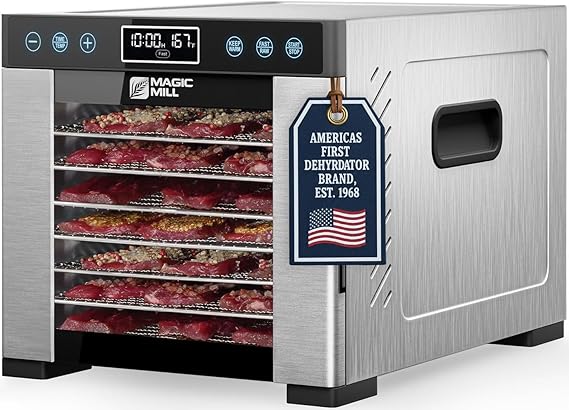
Dehydrators, Bigger batches, even airflow
Magic Mill Pro rear-fan dehydrator
A rear-mounted fan pushes air across every tray, which cuts the tray-rotating chore on big batches.
View on Amazon (opens Amazon in a new tab)