Ingredients
- 1 lb (450 g) lean beef, such as eye of round or top round, trimmed
- 2 tablespoons soy sauce
- 1 tablespoon Worcestershire sauce
- 1 tablespoon brown sugar, packed
- 3/4 teaspoon kosher salt
- 1 garlic clove, crushed
- 1 tablespoon coarsely cracked black pepper, divided
Method
- Trim every visible bit of fat, silver skin, and gristle from the meat. Wrap it and freeze it until firm but not solid, about 1 to 2 hours depending on the size of the piece.
- Slice the firm meat into strips 1/8 to 1/4 inch thick (never thicker than 1/4 inch), about 1 to 1.5 inches wide. Cut with the grain for a chewy jerky or across the grain for a tender, snappier one.
- Mix the soy sauce, Worcestershire sauce, brown sugar, salt, garlic, and half the cracked pepper (1 1/2 teaspoons). Add the strips and massage to coat in a 1 gallon food-grade bag.
- Refrigerate 6 to 12 hours, turning and massaging occasionally.
- Drain the strips on paper towels and pat dry. Press the remaining cracked pepper onto both faces of each strip. Discard the used marinade.
- Test your dehydrator empty with a thermometer and set it to 145°F, preheating for 15 to 30 minutes. Lay the drained strips on the trays close together without touching or overlapping, with some open space for air. Rotate trays every 2 hours if your unit has vertical airflow.
- Dry until a cooled test piece cracks but does not break when bent, with no damp spots. Start checking after 3 hours; cool each test piece before bending it, because hot jerky feels softer than it is.
- Heat step: lay the dried strips in a single layer on a baking sheet, close together but not touching, and place them in an oven preheated to 275°F for 10 minutes (strips 1/4 inch thick or thinner). Thicker strips need longer. Check a few of the thickest strips with a thin-tipped thermometer: they must read at least 160°F. Do this right after drying, while the strips are still warm.
- Blot beads of oil with paper towels and cool the jerky completely to room temperature. Never pack it warm.
- Condition it: loosely pack cooled jerky in a container about two-thirds full, seal, and shake daily for 2 to 4 days. If moisture shows on the lid, return the jerky to the dehydrator or oven. Then pack airtight, label with the date, and refrigerate or freeze.
What makes it work
This recipe follows the Pacific Northwest extension "traditional jerky" ratio (3/4 teaspoon salt, 1 tablespoon brown sugar, 1 garlic clove, 2 tablespoons soy sauce, 1 tablespoon Worcestershire sauce, and pepper, per pound, marinated 6 to 12 hours) and spends the saved flavor budget on pepper. Crack the peppercorns coarsely with a mortar, the flat of a knife, or a spice grinder on its coarsest setting. Fine pepper turns bitter and muddy. Coarse pepper gives you crunch and heat in bursts.
Texture
Because pepper bark sits on the surface, slice with the grain for a chewier bite that holds the crust. Pressing the pepper on after draining keeps it from washing off in the marinade. Pat the pepper in firmly, since it will shrink with the strip as it dries.
Heat note
The heat level here is mild. For more bite, add 1/2 teaspoon cayenne to the marinade. Pepper heat concentrates as the meat dries, so it tastes stronger after drying than it did wet.
The quantities are scaled from tested extension marinades (the National Center for Home Food Preservation and Pacific Northwest recipes). The flavor variations are this site's own formulation and have not been lab tested.
Sources
Gear for this method
As an Amazon Associate we earn from qualifying purchases. These are listings we verified, not products we tested. How our links work.

Dehydrators, The upgrade pick
Cosori 6-tray stainless steel dehydrator
Six stainless trays give a full 3-4 lb batch of strips room to breathe, and adjustable temperature lets you dry at the temperature your tested recipe calls for.
View on Amazon (opens Amazon in a new tab)
Dehydrators, First dehydrator on a budget
Cosori 5-tray dehydrator (165F max)
A compact, low-cost starter with adjustable temperature that tops out at 165F, check that your recipe's drying and pre-heat temperatures fit under that ceiling.
View on Amazon (opens Amazon in a new tab)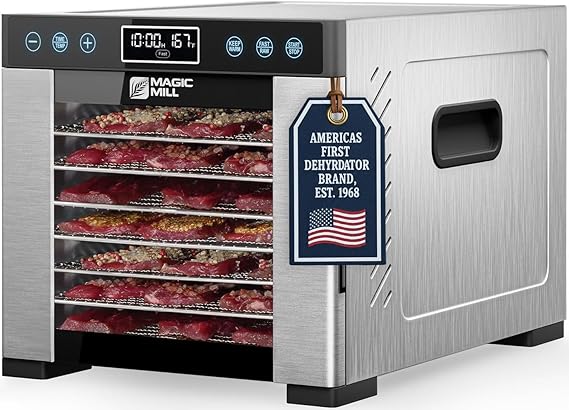
Dehydrators, Bigger batches, even airflow
Magic Mill Pro rear-fan dehydrator
A rear-mounted fan pushes air across every tray, which cuts the tray-rotating chore on big batches.
View on Amazon (opens Amazon in a new tab)