Ingredients
- 1 lb (450 g) lean pork loin or tenderloin, trimmed of all fat
- 2 tablespoons soy sauce
- 2 tablespoons bourbon
- 1 tablespoon brown sugar, packed
- 1 tablespoon Worcestershire sauce
- 1 garlic clove, crushed
- 1/4 teaspoon black pepper
- 1/4 teaspoon onion powder
Method
- Freeze the pork in portions no thicker than 6 inches at 0°F or below for at least 30 days, per extension guidance for pork and game, then thaw it in the refrigerator.
- Trim off all fat, since pork fat goes rancid quickly. Freeze the meat until firm but not solid and slice 1/8 to 1/4 inch thick.
- Mix the soy sauce, bourbon, brown sugar, Worcestershire sauce, garlic, pepper, and onion powder until the sugar dissolves. Add the strips and coat thoroughly.
- Refrigerate 6 to 10 hours, turning occasionally. Discard the marinade afterward.
- Drain and pat the strips dry. Load them on dehydrator trays preheated to a verified 145°F, close together but not touching.
- Dry until a cooled test piece cracks but does not break, with no damp spots. Start checking at hour 3.
- Heat step: lay the dried strips on a baking sheet and heat 10 minutes in an oven preheated to 275°F, then verify 160°F with a thin-tipped thermometer in several of the thickest strips.
- Blot oil, cool completely, condition 2 to 4 days, pack airtight, label, and refrigerate or freeze.
Why pork needs the freezer
The National Center for Home Food Preservation says pork and wild game should be frozen at 0°F or below for at least 30 days in portions no thicker than 6 inches to treat for Trichinella. Freezing does not remove bacteria, which is why the 160°F heat step remains.
About the bourbon
Bourbon adds sweet oak and vanilla notes. It is a seasoning, and we make no claim about alcohol remaining or not remaining in the finished jerky. Leave it out and add 1 tablespoon apple juice if you want an alcohol-free batch.
Lean pork only
Pork shoulder and belly have far too much fat for jerky. Loin and tenderloin trim easily and have a mild flavor that takes on the marinade well.
The quantities are scaled from tested extension marinades (the National Center for Home Food Preservation and Pacific Northwest recipes). The flavor variations are this site's own formulation and have not been lab tested.
Sources
- NCHFP / University of Georgia: Jerky
- Pacific Northwest Extension PNW 632: Making Jerky at Home Safely
- Kansas State University Extension MF3173: Dehydrating Meat Safely at Home
- Ohio State University Extension HYG-5362: Making Jerky
- South Dakota State University Extension: Home-Dried Jerky Process and Tips
Gear for this method
As an Amazon Associate we earn from qualifying purchases. These are listings we verified, not products we tested. How our links work.

Dehydrators, The upgrade pick
Cosori 6-tray stainless steel dehydrator
Six stainless trays give a full 3-4 lb batch of strips room to breathe, and adjustable temperature lets you dry at the temperature your tested recipe calls for.
View on Amazon (opens Amazon in a new tab)
Dehydrators, First dehydrator on a budget
Cosori 5-tray dehydrator (165F max)
A compact, low-cost starter with adjustable temperature that tops out at 165F, check that your recipe's drying and pre-heat temperatures fit under that ceiling.
View on Amazon (opens Amazon in a new tab)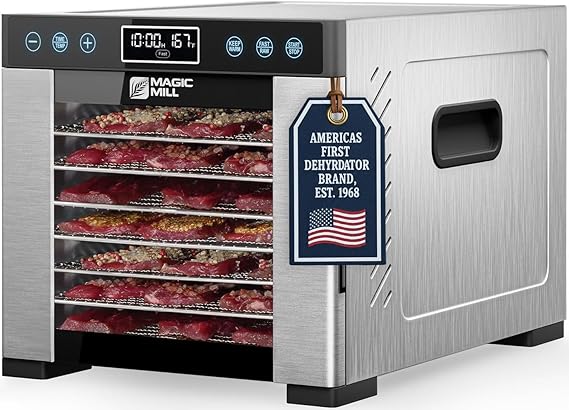
Dehydrators, Bigger batches, even airflow
Magic Mill Pro rear-fan dehydrator
A rear-mounted fan pushes air across every tray, which cuts the tray-rotating chore on big batches.
View on Amazon (opens Amazon in a new tab)