Ingredients
- 1 lb (450 g) skinless chicken breast or thigh, trimmed of all fat
- 2 tablespoons fresh lime juice
- 1 teaspoon finely grated lime zest
- 1 tablespoon soy sauce
- 1 jalapeno, seeded and minced (about 1 tablespoon)
- 1 garlic clove, crushed
- 1 teaspoon brown sugar
- 1/2 teaspoon ground cumin
- 1/4 teaspoon kosher salt
Method
- Keep raw chicken at 40°F or below and use it within 2 days, or freeze it. Wash hands for at least 20 seconds after handling it, and sanitize the board and knife.
- Trim off all skin, fat, and gristle. Freeze the meat until firm but not solid and slice 1/8 to 1/4 inch thick.
- Combine the lime juice, zest, soy sauce, jalapeno, garlic, sugar, cumin, and salt. Add the strips, coat well, and refrigerate 4 to 6 hours. Lime juice firms the surface of lean meat, so keep the soak short.
- Preheat the oven to 325°F. Drain the strips, discard the marinade, and lay them close together, not touching, on lightly oiled racks over baking sheets.
- Bake until a thin-tipped thermometer reads at least 165°F in several of the thickest strips, then start drying immediately.
- Load the hot strips on trays in a dehydrator preheated to a verified 145°F. Dry until a cooled test piece cracks but does not break, checking from hour 3. Do not overdry.
- Blot oil, cool completely, and condition 2 to 4 days in a container two-thirds full. Pack airtight, label as poultry with the date, and keep it refrigerated or frozen.
Heat control
Seeding the jalapeno takes most of the heat out, since the pith and seeds hold it. Leave a few seeds in for a hotter batch. The heat concentrates as the strips dry.
Why thigh is worth trying
Thigh meat has more fat and more flavor, and it stays slightly more tender after drying. It also needs more trimming. Either cut works with the same method, and the Pacific Northwest bulletin names breast, thigh, and leg as the best poultry cuts.
Fresh ingredients
Because fresh lime and jalapeno do not store like dried spices, plan to use the jerky promptly and keep it cold.
The quantities are scaled from tested extension marinades (the National Center for Home Food Preservation and Pacific Northwest recipes). The flavor variations are this site's own formulation and have not been lab tested.
Sources
- Pacific Northwest Extension PNW 632: Making Jerky at Home Safely
- NCHFP / University of Georgia: Jerky
- Kansas State University Extension MF3173: Dehydrating Meat Safely at Home
- Ohio State University Extension HYG-5362: Making Jerky
- USDA/HHS FoodSafety.gov: Safe Minimum Internal Temperature Chart
- South Dakota State University Extension: Home-Dried Jerky Process and Tips
Gear for this method
As an Amazon Associate we earn from qualifying purchases. These are listings we verified, not products we tested. How our links work.

Dehydrators, The upgrade pick
Cosori 6-tray stainless steel dehydrator
Six stainless trays give a full 3-4 lb batch of strips room to breathe, and adjustable temperature lets you dry at the temperature your tested recipe calls for.
View on Amazon (opens Amazon in a new tab)
Dehydrators, First dehydrator on a budget
Cosori 5-tray dehydrator (165F max)
A compact, low-cost starter with adjustable temperature that tops out at 165F, check that your recipe's drying and pre-heat temperatures fit under that ceiling.
View on Amazon (opens Amazon in a new tab)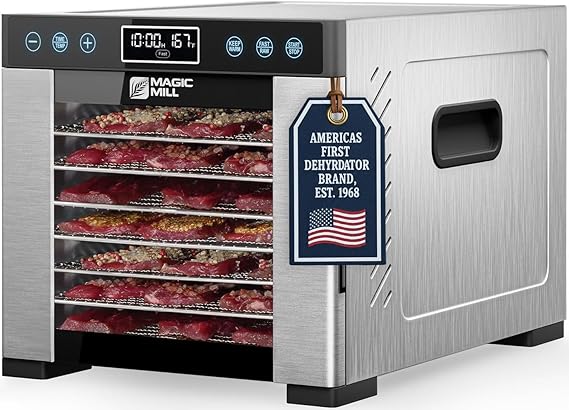
Dehydrators, Bigger batches, even airflow
Magic Mill Pro rear-fan dehydrator
A rear-mounted fan pushes air across every tray, which cuts the tray-rotating chore on big batches.
View on Amazon (opens Amazon in a new tab)