Ingredients
- 1 lb (450 g) lean venison from deer or elk (round, loin, or flank), trimmed of all fat and silver skin
- 2 tablespoons soy sauce
- 2 teaspoons Worcestershire sauce
- 1/4 teaspoon black pepper
- 1/4 teaspoon garlic powder
- 1/2 teaspoon onion powder
- 1/2 teaspoon hickory smoke-flavored salt
- 1 teaspoon brown sugar (optional)
Method
- Start with venison that was field dressed without gut contamination, chilled quickly, and frozen at 0°F or below for at least 30 days in portions no thicker than 6 inches. Thaw it in the refrigerator.
- If you are in a CWD area, confirm the animal tested negative or follow your state agency's guidance before eating any meat. Do not use meat from an animal that tested positive.
- Trim away every bit of fat, silver skin, and gristle. Wrap and freeze the meat until firm but not solid, then slice 1/8 to 1/4 inch thick, with the grain for chew.
- Mix the soy sauce, Worcestershire sauce, pepper, garlic powder, onion powder, hickory salt, and sugar. Add the strips, cover, and refrigerate 4 to 8 hours. Discard the marinade afterward.
- Preheat the oven to 325°F. Drain the strips and lay them close together, not touching, on wire racks set over baking sheets. Bake until a thin-tipped thermometer reads at least 160°F in several of the thickest strips, then start drying immediately.
- Set the dehydrator to a verified 145°F, preheated, and load the hot strips close together without touching. Dry until a cooled test piece cracks but does not break when bent, with no damp spots.
- Blot oil, cool completely, and condition 2 to 4 days in a container two-thirds full, shaking daily. Pack airtight, label as venison with the date, and refrigerate or freeze.
Why we precook venison
Both heat methods (precooking, or the 275°F oven step after drying) are accepted for jerky. We use the precook bake here because the Pacific Northwest bulletin says adequate heating kills Trichinella species that freezing and ordinary drying do not, and a thermometer reading before drying is clear proof the step happened. If you prefer the traditional texture, skip the bake and use the 275°F step for 10 minutes after drying, verifying 160°F.
The marinade
The marinade is the National Center for Home Food Preservation recipe, written there for 1.5 to 2 pounds of meat, scaled to 1 pound. Venison is lean and mild, so it handles smoky and peppery flavors. Do not skip trimming, because game fat tastes waxy and goes rancid quickly.
Handling reminders
Field handling decides whether this recipe is safe to begin with. See the venison guide for CWD guidance, bone-out advice, and the freezing rules, and check your state wildlife agency for current local requirements.
The quantities are scaled from tested extension marinades (the National Center for Home Food Preservation and Pacific Northwest recipes). The flavor variations are this site's own formulation and have not been lab tested.
Sources
- NCHFP / University of Georgia: Jerky
- Pacific Northwest Extension PNW 632: Making Jerky at Home Safely
- Kansas State University Extension MF3173: Dehydrating Meat Safely at Home
- CDC: About Chronic Wasting Disease (CWD)
- Penn State: Hunting deer despite disease, be smart and safe
- South Dakota State University Extension: Home-Dried Jerky Process and Tips
Gear for this method
As an Amazon Associate we earn from qualifying purchases. These are listings we verified, not products we tested. How our links work.

Dehydrators, The upgrade pick
Cosori 6-tray stainless steel dehydrator
Six stainless trays give a full 3-4 lb batch of strips room to breathe, and adjustable temperature lets you dry at the temperature your tested recipe calls for.
View on Amazon (opens Amazon in a new tab)
Dehydrators, First dehydrator on a budget
Cosori 5-tray dehydrator (165F max)
A compact, low-cost starter with adjustable temperature that tops out at 165F, check that your recipe's drying and pre-heat temperatures fit under that ceiling.
View on Amazon (opens Amazon in a new tab)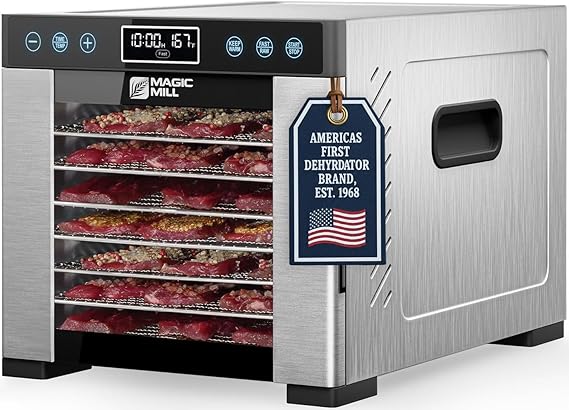
Dehydrators, Bigger batches, even airflow
Magic Mill Pro rear-fan dehydrator
A rear-mounted fan pushes air across every tray, which cuts the tray-rotating chore on big batches.
View on Amazon (opens Amazon in a new tab)